

UnitPriceCheck LogoUnitPriceCheck

Price Per Item Calculator

Compare products sold by numerical count rather than weight or volume. Calculate the true cost per piece for dishwasher pods, batteries, trash bags, diapers, eggs, and multipacks.

Dishwasher and laundry podsDiapers, trash bags, and paper goodsMultipack piece count math
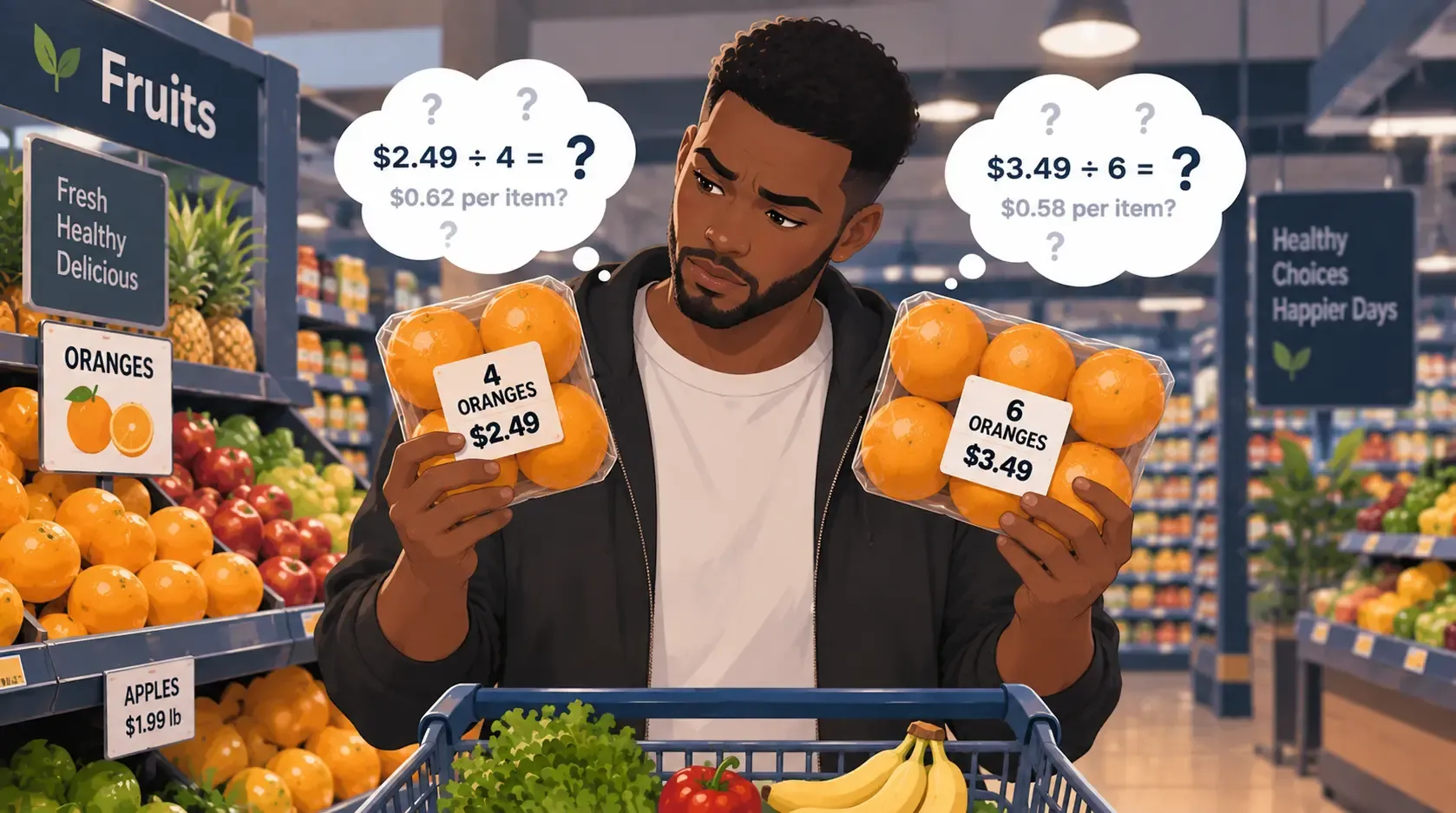
Shopper comparing package sizes to calculate price per item
item
How to Calculate Price Per ItemTo find the price per item (cost per piece, count, or unit), divide the total package retail price by the total number of individual items contained inside.
Price Per Item = Total Package Price / Total Piece Count
1

Option 1

$
item
2

Option 2

$
item
Ready to compare

Enter a price and size for both options above.

Results update automatically as you type.

Comparing multipacks?

Tap the + Multipack button above to enter item count, or enter the total combined quantity into the Size field (e.g. 6-pack of 12 oz entered as 72 oz).

General Need

Need a general unit price calculator?

Use the main UnitPriceCheck calculator for flexible comparisons across different unit types.

Specific Need

Looking for a specific calculator?

Browse the calculator directory to find the tool for your exact comparison.

Common Price Per Item Benchmarks

Standard retail pack sizes and resulting unit prices per piece

75 Dishwasher Pods$0.227 / podClub box ($16.99)
24 AA Batteries$0.583 / eachBulk contractor pack ($13.99)
80 Trash Bags$0.181 / bag13-gallon box ($14.49)
18 Large Eggs$0.249 / eggFamily carton ($4.49)

The Economics of Count-Based Products: Why Per-Piece Math Wins

The price per item (often termed price per unit, price per piece, or cost per count) determines the exact financial cost of one individual consumable item within a larger container. While grocery shoppers naturally think of unit pricing in terms of ounces, pounds, or liters for food, an immense portion of household spending occurs in non-food consumable categories where weight is completely irrelevant to how the product is used.

When you load your dishwasher, you insert exactly one detergent pod, regardless of whether that pod weighs 18 grams or 22 grams. When you line your kitchen trash can, you use exactly one bag. When you replace the batteries in a smoke detector or game controller, you require exactly two or four individual batteries. In each of these everyday routines, your true operational expense is strictly determined by the cost per piece.

Manufacturers understand that shoppers struggle to perform rapid division on arbitrary quantities like 38-count, 74-count, or 112-count boxes. By altering package quantities rather than adjusting prices, brands make direct price comparisons difficult. Calculating the price per item cuts through non-standard box counts, exposing which pack size delivers the lowest cost per use.

The Fundamental Price Per Item Formulas
Price Per Item = Total Package Price ÷ Total Piece Count
Bundled Multi-Packs:

Price Per Item = Price ÷ (Packs × Items per Pack)

Annualized Savings:

Annual Savings = (Price Difference per Item) × Annual Count

How to Calculate Price Per Item Step by Step

Follow these practical steps when shopping the household, baby, or battery aisles:

1

Identify Total Count

Find the total number of individual pieces printed on the front of the box (e.g. 48 count, 90 tablets, 120 bags).

2

Divide Package Price

Divide the register price by the total piece count. For a $11.49 tub of 36 pods: $11.49 ÷ 36 = $0.3192 per pod (31.9¢).

3

Repeat for Option 2

Perform the identical division for the competing brand or larger club box to obtain both individual unit rates.

4

Verify Piece Savings

Subtract the lower cost per piece from the higher rate. Multiply that savings by your monthly usage to calculate real household dollar savings.

Real-World Household Comparisons: Price per Item in Action

Examining count-based goods reveals why purchasing small retail packages is one of the fastest ways to overspend on non-perishable necessities:

Example 1: Dishwasher Detergent Pods (36 Count Pouch vs 110 Count Tub)

Cleaning Aisle

Dishwasher pods are packaged in flexible 36-count stand-up pouches and larger 110-count rigid plastic tubs of identical formulation.

Option A: 36 Count Pouch

Count: 36 pods | Price: $11.49

$11.49 ÷ 36 pods = $0.3192 per pod (31.9¢)

Option B: 110 Count Club Tub (Winner)

Count: 110 pods | Price: $22.99

$22.99 ÷ 110 pods = $0.2090 per pod (20.9¢)

Verdict: The 110-count tub cuts your cost per dishwashing cycle by 34.5% ($0.1102 saved per load). Running one cycle daily saves approximately $40.22 per year on clean dishes.

Example 2: AA Alkaline Batteries (8-Pack Blister vs 48-Pack Box)

Hardware & Electronics

Batteries feature massive retail markups in small hanging blister packs compared to industrial contractor boxes.

Option A: 8-Battery Blister Pack

Count: 8 batteries | Price: $7.99

$7.99 ÷ 8 = $0.9988 per battery ($1.00 each)

Option B: 48-Battery Contractor Box (Winner)

Count: 48 batteries | Price: $21.99

$21.99 ÷ 48 = $0.4581 per battery (45.8¢ each)

Verdict: Buying the contractor box saves 54.1% per battery. Modern alkaline batteries maintain a 10-year shelf life, making the larger pack an undisputed financial bargain.

Example 3: Kitchen Trash Bags (40 Count Box vs 140 Count Mega-Box)

Paper & Plastics

Standard 13-gallon drawstring trash bags are household necessities with infinite shelf stability, making unit price per bag paramount.

Option A: 40 Count Retail Box

Count: 40 bags | Price: $8.99

$8.99 ÷ 40 bags = $0.2248 per bag (22.5¢)

Option B: 140 Count Mega-Box (Winner)

Count: 140 bags | Price: $21.99

$21.99 ÷ 140 bags = $0.1571 per bag (15.7¢)

Verdict: The 140-count box saves 30.1% per bag ($0.0677 saved on every trash day). Over 140 bags, you pocket $9.48 in direct cash savings.

Example 4: Large Grade A Eggs (1 Dozen Carton vs 30-Egg Flat)

Dairy & Eggs

Supermarkets sell eggs in 12-count cartons, 18-count cartons, and 30-egg cardboard flats of identical size grade.

Option A: 1 Dozen (12 Eggs)

Count: 12 eggs | Price: $3.29

$3.29 ÷ 12 eggs = $0.2742 per egg (27.4¢)

Option B: 30-Egg Cardboard Flat (Winner)

Count: 30 eggs | Price: $6.79

$6.79 ÷ 30 eggs = $0.2263 per egg (22.6¢)

Verdict: Buying the flat saves 17.5% per egg ($0.0479 saved per egg). For a household eating two eggs per morning, purchasing flats saves roughly $35 annually on breakfast.

Categories Where Price Per Item Matters Most

Whenever products are utilized one unit at a time, evaluating costs on a per-item basis delivers major savings:

Baby Diapers & Wipes

Diaper boxes range from 28-count jumbo packs to 160-count club boxes. Calculating cost per diaper is essential because infants consume 6 to 10 diapers daily. A 6¢ difference per diaper equals hundreds of dollars over infancy.

Coffee Pods & Capsules

K-Cup and espresso pods are sold in 10, 24, 72, and 120 counts. Calculating per capsule reveals whether each morning mug costs 38¢ or 75¢, allowing instant assessment of single-serve convenience costs.

Vitamins & Supplements

Multivitamin and fish oil bottles contain 30, 60, 120, or 250 softgels. Calculating price per tablet prevents overpaying for smaller 30-day bottles that require monthly re-purchasing.

Count Goods Reference: Standard Pack Sizes and Per-Item Economics

This reference chart outlines typical retail package counts, common price points, and benchmark per-piece costs across popular household goods:

Standard Retail Count Benchmarks and Unit Costs

CategoryStandard CountIllustrative Shelf PricePrice Per ItemTarget Value Benchmark
Dishwasher Pods75 tablets$16.99$0.227 per podUnder 22¢ per cycle represents strong value
AA Batteries24 batteries$13.99$0.583 eachUnder 50¢ each in bulk contractor packs
13-Gal Trash Bags80 bags$14.49$0.181 per bagUnder 17¢ per bag in warehouse sizes
Baby Diapers (Size 3)136 diapers$32.99$0.243 per diaperUnder 25¢ per diaper in club boxes
K-Cup Coffee Pods72 pods$29.99$0.417 per podUnder 40¢ per pod represents solid savings
Large Eggs18 eggs$4.49$0.249 per eggUnder 25¢ per egg in 18-packs and flats

The Paper Goods Trap: Rolls vs Sheets vs Mega Rolls

When shopping for paper towels or bath tissue, comparing by "roll" count is completely meaningless. Manufacturers invent arbitrary terminology like "Double Roll," "Mega Roll," and "Super Mega Roll," claiming that "6 Mega Rolls = 24 Regular Rolls."

To calculate genuine price per item on paper products, check the fine print at the bottom of the package for total sheet count or total square footage. For example, Brand A may offer 12 rolls containing 110 sheets per roll (1,320 total sheets) for $14.99 ($0.0114 per sheet), while Brand B offers 12 rolls containing only 75 sheets per roll (900 total sheets) for $12.99 ($0.0144 per sheet). Although Brand B costs $2.00 less at the register, it is 26.3% more expensive per usable sheet. Always treat the individual sheet or square foot as the true item.

Smart Count Buying Strategies vs Traps

Smart Count Shopping Strategies

  • ✓Check diaper stage counts: Diaper box prices stay flat across stages while counts drop. Recalculate your price per diaper whenever switching to a larger size.
  • ✓Leverage the multipack toggle: For bundles with multiple packs (e.g., 4 boxes of 12 trash bags), use our '+ Multipack' feature to calculate the exact combined unit cost.
  • ✓Buy shelf-stable items in contractor counts: Alkaline batteries (10-year life) and trash bags deliver 30% to 50% savings when purchased in 48+ count boxes.
  • ✓Check warehouse flats for eggs: 30-egg cardboard flats consistently beat 12-count retail cartons by 15% to 25% on a per-egg basis.

Count-Based Traps to Avoid

  • ✕Comparing paper towels by the roll: "Double" and "Mega" roll claims are deceptive. Always divide by total sheet count or total square footage.
  • ✕Buying small impulse blister packs: Checkout-lane 4-packs of batteries carry markups over 100% compared to hardware aisle boxes.
  • ✕Assuming mega-packs are always cheaper: Promotional sales regularly discount 30-count pouches while 90-count tubs remain at full price. Always calculate both.
  • ✕Ignoring home storage capacity: Buying 200 trash bags saves money only if you have dry, accessible closet or pantry space to store them.

Frequently Asked Questions About Price Per Item

What is the difference between price per item and cost per serving?

Price per item measures individual physical pieces (like a battery, trash bag, or dishwasher pod). Cost per serving measures nutritional portions from bulk foods (like scoops of protein powder or bowls of cereal). If you are evaluating food portions, visit our Cost Per Serving Calculator.

How do I compare two packages with different roll counts of paper towels?

Do not enter roll counts. Instead, find the total sheet count or total square feet printed on the bottom front of the package. Enter that sheet count into our calculator as your quantity. This neutralizes misleading "double roll" claims and compares true paper volume.

Can I use this calculator to compare egg prices across pack sizes?

Yes. Enter 12 for a standard dozen, 18 for an 18-pack, and 30 for a cardboard flat. The calculator immediately divides each shelf price by the egg count to display your cost per egg and the percentage savings.

How does the '+ Multipack' toggle work for count products?

If comparing a bundle containing four 12-count boxes of trash bags against a single 50-count box, activate '+ Multipack' on Product 1. Enter 4 as pack count and 12 as item count. The tool computes 48 total bags and calculates unit price seamlessly.

Why do battery prices vary so drastically per piece?

Small 4-packs and 8-packs placed near the checkout register carry heavy impulse-purchase markups and high blister packaging costs. Contractor boxes of 24 or 48 batteries sold in hardware or wholesale aisles carry minimal packaging overhead, cutting the cost per battery by over 50%.

Are larger count boxes always cheaper per item?

Usually, but not always. During promotional weekly sales, grocery chains occasionally discount 30-count laundry pod pouches deeply while keeping 90-count tubs at full retail price. Always run both quantities through the calculator to verify the current deal.

Can I compare count items against items sold by weight?

No. A count-based item (such as an individual apple or egg) cannot be mathematically compared to an item sold strictly by the pound or ounce without knowing the average individual weight of that item. Both items must share count units to evaluate cost per piece.