

UnitPriceCheck LogoUnitPriceCheck

Cost Per Serving Calculator

Determine the exact cost per meal, scoop, bowl, or snack portion. Compare nutrition panel servings across protein powders, breakfast staples, coffee, and pantry staples in real time.

Protein powders and supplementsBreakfast, coffee, and meal prepPortion-based budget clarity
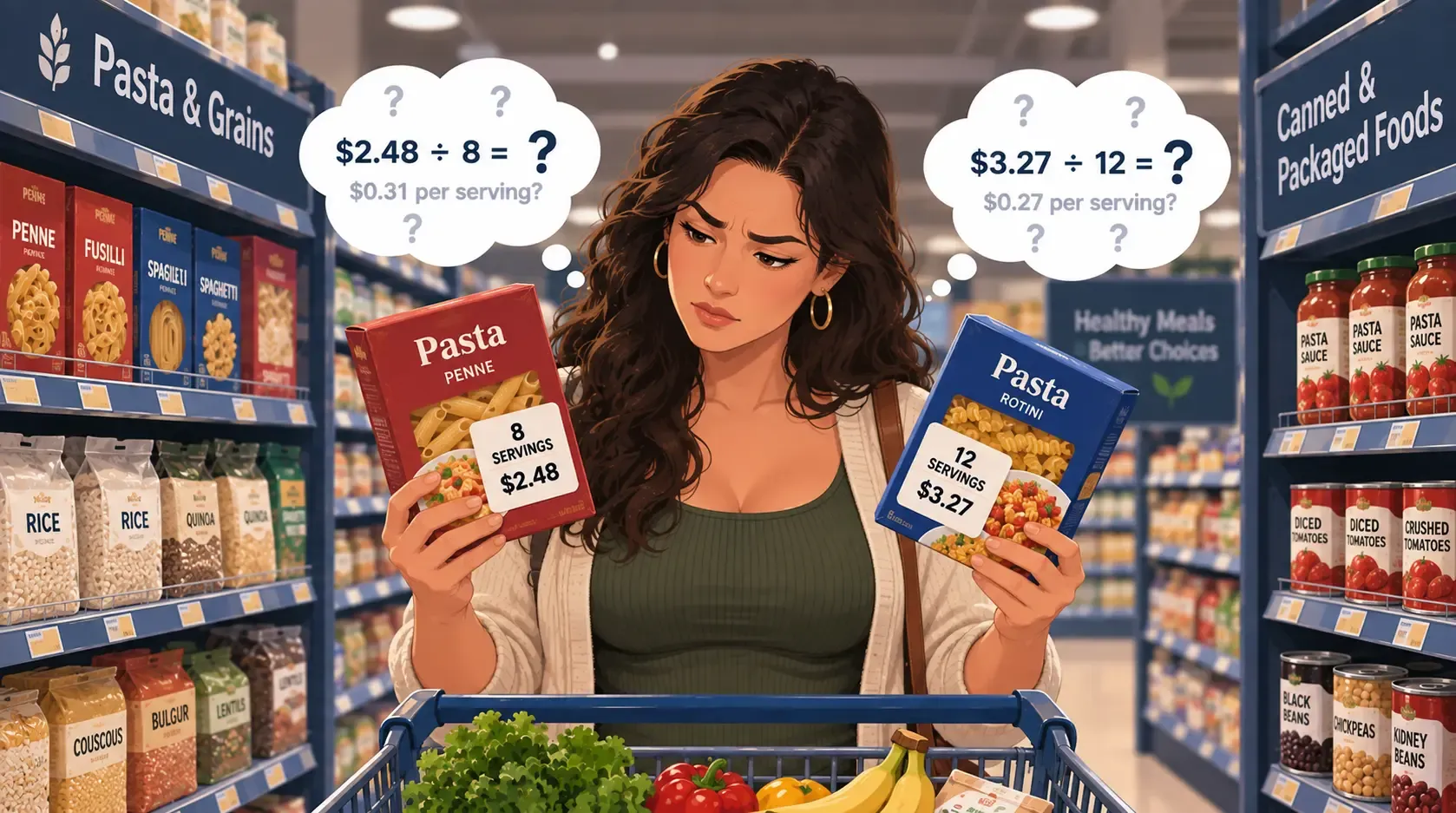
Shopper comparing food products to calculate cost per serving
serv
How to Calculate Cost Per ServingTo find the cost per serving, divide the total package retail price by the total number of nutritional servings or portions in the container.
Cost Per Serving = Total Package Price / Total Servings
1

Option 1

$
serving
2

Option 2

$
serving
Ready to compare

Enter a price and size for both options above.

Results update automatically as you type.

Comparing multipacks?

Tap the + Multipack button above to enter item count, or enter the total combined quantity into the Size field (e.g. 6-pack of 12 oz entered as 72 oz).

General Need

Need a general unit price calculator?

Use the main UnitPriceCheck calculator for flexible comparisons across different unit types.

Specific Need

Looking for a specific calculator?

Browse the calculator directory to find the tool for your exact comparison.

Common Cost Per Serving Benchmarks

Standard nutritional portions and resulting unit costs per serving

Rolled Oats Canister$0.150 / bowl30 servings ($4.49)
Ground Drip Coffee$0.264 / cup34 cups ($8.99)
Whey Protein Powder$0.867 / shake75 scoops ($64.99)
Dry Brown Rice$0.120 / side50 servings ($5.99)

Demystifying Cost Per Serving in Household Food Budgeting

The cost per serving represents the standardized financial expense of preparing or consuming one individual nutritional portion of a food or beverage product. While weight-based unit pricing (such as price per ounce or pound) is critical for comparing identical raw commodities, cost per serving becomes essential when comparing prepared foods, nutritional supplements, and convenience products with varying densities, moisture levels, or dilution ratios.

Consider breakfast options. A box of pre-portioned flavored instant oatmeal packets contains 10 individual paper envelopes and sells for $4.29. A standard 42-ounce cardboard canister of whole rolled oats right next to it sells for $4.49. At first glance, both products appear to cost almost the same at the cash register. But checking the Nutrition Facts panel reveals that the bulk canister contains 30 generous whole grain servings, whereas the packet box contains only 10 smaller servings.

In portion terms, the bulk canister costs 15¢ per breakfast bowl, while the convenience packets cost 43¢ per bowl. That represents a 186% convenience markup. Standardizing food costs to the individual serving level empowers fitness meal planners, busy families, and budget-conscious cooks to evaluate what their daily nutrition actually costs to put on the table.

The Fundamental Cost Per Serving Formulas
Cost Per Serving = Total Package Price ÷ Total Servings in Container
Finding Total Servings from Net Weight:

Servings = Total Net Weight (g) ÷ Serving Size (g)

Cost Per Meal (Multi-Ingredient):

Cost Per Meal = Total Recipe Ingredient Cost ÷ Yielded Portions

How to Calculate Cost Per Serving from Nutrition Labels

Follow this simple process when examining food packaging in store aisles:

1

Check Servings Line

Locate the 'Servings Per Container' line printed directly below the Nutrition Facts header. Note the exact numeric serving count.

2

Verify Serving Size

Confirm that the serving size reflects your realistic portion (e.g. 1 scoop / 32g, or 1/2 cup / 40g dry).

3

Divide Shelf Price

Divide the package price by the total servings. In our calculator, select 'item' as the unit and type the serving count into the quantity box.

4

Evaluate Savings

Compare with Product 2 to see which brand delivers lower portion costs and view your cumulative monthly savings.

Real-World Cost Per Serving Comparisons

Examine these real-life dietary and grocery examples showing how calculating cost per serving reveals substantial budget differences:

Example 1: Whey Protein Powder (2 lb Tub vs 5 lb Bag)

Fitness & Supplements

Both products provide an identical 24g of protein per 30g scoop. Evaluating cost per serving prevents overpaying for small tubs.

Option A: 2 lb Tub (30 Servings)

Price: $34.99 | Yield: 30 scoops

$34.99 ÷ 30 servings = $1.166 per shake ($1.17)

Option B: 5 lb Bag (75 Servings, Winner)

Price: $64.99 | Yield: 75 scoops

$64.99 ÷ 75 servings = $0.867 per shake (86.7¢)

Verdict: The 5 lb bag saves 25.7% per serving ($0.30 saved per daily shake). Consuming one protein shake daily yields $109.50 in annual savings.

Example 2: Daily Coffee (K-Cup Pods vs Home Drip Grounds)

Beverages & Breakfast

Evaluating single-serve convenience capsules against conventional bag coffee by mug serving.

Option A: 24-Pack K-Cup Pods

Price: $15.99 | Yield: 24 cups

$15.99 ÷ 24 cups = $0.666 per mug (66.6¢)

Option B: 12 oz Bag Drip Coffee (Winner)

Price: $7.99 | Yield: 34 cups (10g / cup)

$7.99 ÷ 34 cups = $0.235 per mug (23.5¢)

Verdict: Brewing drip coffee saves 64.7% per morning mug ($0.431 saved per cup). For a two-cup-a-day household, switching from pods to grounds keeps $314.63 in your bank account every year.

Example 3: Breakfast Oatmeal (Flavored Packets vs Canister)

Pantry & Cereal

Comparing flavored single-serve instant packets against a traditional 42 oz cylindrical canister of whole oats.

Option A: Instant Packets (10 Count)

Price: $4.29 | Yield: 10 servings

$4.29 ÷ 10 = $0.429 per serving (42.9¢)

Option B: 42 oz Canister Rolled Oats (Winner)

Price: $4.49 | Yield: 30 servings (40g dry)

$4.49 ÷ 30 = $0.150 per serving (15.0¢)

Verdict: The bulk canister delivers 65.0% lower cost per bowl. Adding your own cinnamon, raisins, and honey takes 30 seconds and eliminates artificial sweeteners and excess sodium.

Example 4: Work Lunches (Frozen Prepared Meals vs Batch Chili)

Meal Prep & Cooking

Evaluating supermarket frozen entree bowls against home slow-cooker batch cooking.

Option A: Frozen Diet Entrees (4 Trays)

Price: $15.96 ($3.99 each) | Yield: 4 meals

$15.96 ÷ 4 meals = $3.99 per lunch

Option B: Slow-Cooker Turkey Chili (Winner)

Ingredients: $11.50 total | Yield: 5 hearty portions

$11.50 ÷ 5 meals = $2.30 per lunch

Verdict: Batch meal prep saves 42.4% per meal ($1.69 saved per workday). Over a 50-week work year (250 lunches), cooking at home retains $422.50 while providing double the fresh protein and fiber.

Serving Cost Reference: Household Staples and Benchmark Portions

This reference chart outlines standard serving sizes, average container servings, typical price points, and benchmark portion costs:

Household Dietary Staples and Target Cost Per Serving Benchmarks

Food CategoryStandard Serving UnitContainer ServingsIllustrative PriceCost Per ServingTarget Value Benchmark
Rolled Oats Canister40g dry (1/2 cup)30 servings$4.49$0.150 per bowlUnder 18¢ per bowl in large canisters
Ground Coffee (Drip)10g grounds (6 oz cup)34 cups$8.99$0.264 per cupUnder 30¢ per cup for quality beans
Whey Protein Powder30g scoop (24g protein)75 scoops$64.99$0.867 per shakeUnder 95¢ per shake in 5 lb bags
Plain Greek Yogurt170g (3/4 cup)5.3 servings$4.99$0.942 per portionUnder $1.00 per portion in 32 oz tubs
Dry Brown Rice45g dry (1/4 cup)50 servings (5 lb)$5.99$0.120 per sideUnder 15¢ per side in 5 lb bags
Frozen Mixed Berries140g (1 cup)10 servings (3 lb)$9.99$0.999 per smoothieUnder $1.05 per smoothie in bulk bags

Smart Serving-Based Strategies vs Traps

Smart Serving Budget Strategies

  • ✓Check scoop weight on supplements: Compare protein powder costs by grams of active protein delivered rather than arbitrary manufacturer scoop sizes.
  • ✓Buy bulk canisters for breakfast staples: 42 oz canisters of rolled oats cut portion costs by 65% compared to pre-measured single-serve packets.
  • ✓Portion your own snack bags: Spending 10 minutes dividing large bags of almonds into reusable containers eliminates 200% single-serve packaging markups.
  • ✓Batch cook meals: Preparing 5 work lunches from raw whole ingredients cuts meal costs by over 40% compared to frozen supermarket entree trays.

Serving Size Traps to Avoid

  • ✕Trusting unrealistic label portions: Canned soups claiming '2.5 servings' are eaten as 1 bowl. Calculate cost per serving based on what you actually consume.
  • ✕Ignoring food waste and spoilage: Buying 8 servings of fresh soup saves money only if all 8 are eaten before spoiling in the refrigerator.
  • ✕Comparing coffee by weight rather than cups: Comparing grounds to pods by weight confuses packaging tare with brewed coffee volume. Compare per brewed mug.
  • ✕Overpaying for pre-mixed protein shakes: Ready-to-drink bottled shakes cost $2.50 to $3.50 each versus 87¢ per serving from dry powder tubs.

Frequently Asked Questions About Cost Per Serving

Where do I find the serving count on a packaged food product?

Look at the Nutrition Facts panel, usually printed on the back or side of the container. The top line directly beneath the bold title indicates 'Servings Per Container' followed by a number (for example, 'About 8 servings').

How do I use this calculator for serving comparisons?

Select 'item' in the unit dropdown on both products. Enter the shelf price for each option and enter the serving count into the quantity input field. The calculator immediately divides price by servings to show your exact portion cost and percentage savings.

What if my actual portion size is different from the label?

Divide total container weight by your custom portion weight. For example, if a 900g cereal box lists serving size as 30g (30 servings), but you pour 45g bowls, your actual container yield is 900g ÷ 45g = 20 servings. Enter 20 into the calculator to reflect your real personal cost per bowl.

Can I use this tool for home-cooked meal prep recipes?

Yes. Sum the total cost of all recipe ingredients (e.g. $16.50 for a batch of chili) and enter that into the price field. Enter the number of meal containers you pack (e.g. 5 lunch portions). The tool outputs your exact prepared cost per meal ($3.30).

How do I calculate cost per gram of protein in protein powders?

Multiply total servings by grams of protein per serving to find total container protein. Then divide the tub price by total protein grams. For instance, a tub with 30 servings at 25g protein contains 750g protein. At $30.00, it costs $30.00 ÷ 750g = $0.04 per gram of pure protein.

Why is cost per serving better than price per ounce for coffee?

Comparing ground coffee by the ounce against single-serve K-Cup pods by the ounce is confusing because plastic pod cups add tare weight and require specialized machines. Comparing them on a per-cup basis directly measures what you pay for each morning mug.

Does cost per serving account for food spoilage?

Only if you eat all servings. If you buy a large family soup pot containing 8 servings for $8.00 ($1.00/serving), but end up throwing away 3 servings that spoil in the fridge, your effective cost for the 5 eaten servings rises to $8.00 ÷ 5 = $1.60 per serving.