

UnitPriceCheck LogoUnitPriceCheck

Price Per Pound Calculator

Compare meat cuts, fresh produce, deli orders, and wholesale warehouse club packs. Calculate the exact cost per pound side by side to make confident grocery decisions.

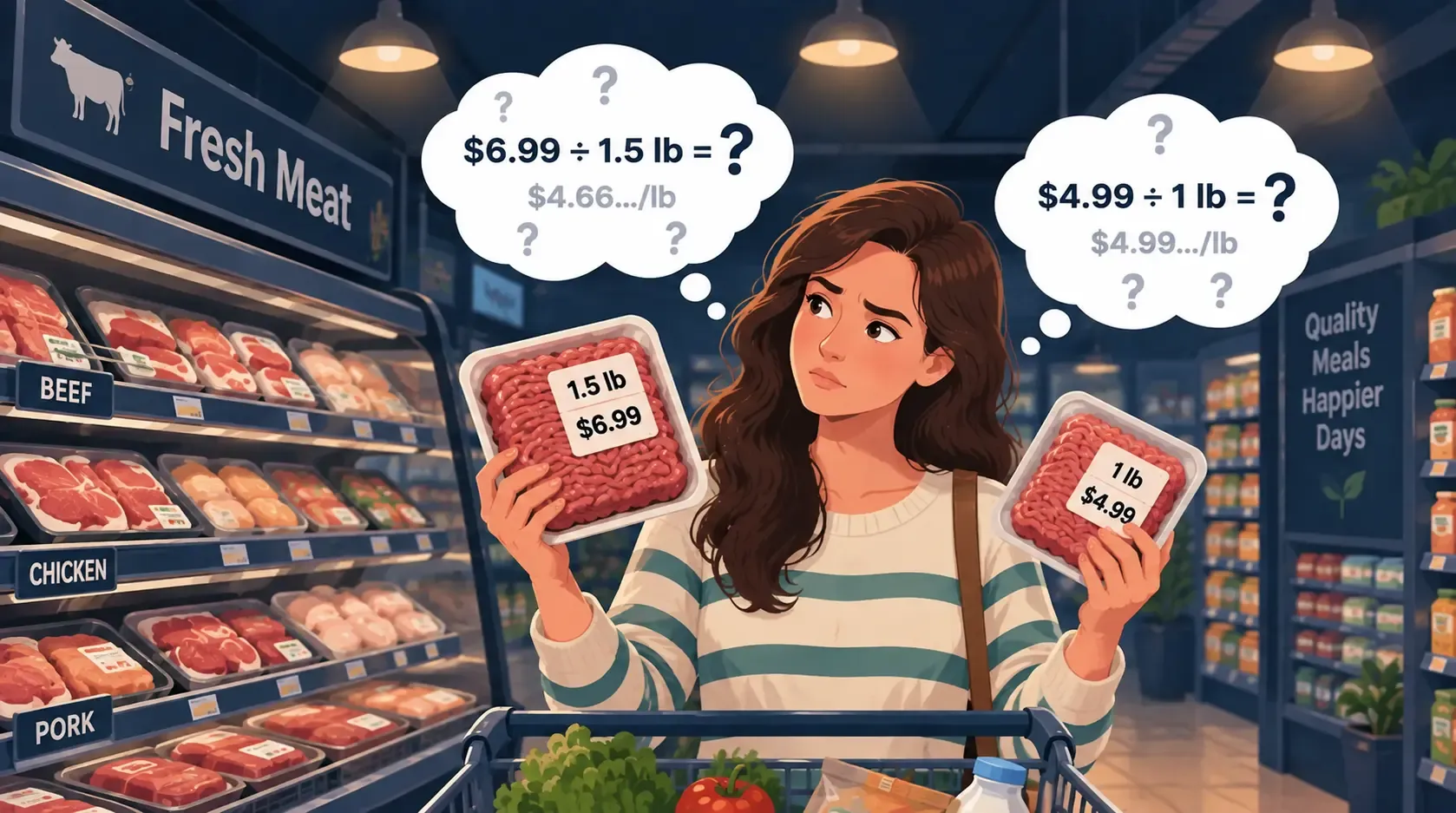
Shopper comparing packaged meat prices to calculate price per pound
lb
The Core Rule: Price Per Pound = Total Price ÷ Net Weight in PoundsCompare butcher value packs, pre-bagged produce, and wholesale club portions
$8.99 ÷ 2.5 lb = $3.60 / lb
1

Option 1

$
lb
2

Option 2

$
lb
Ready to compare

Enter a price and size for both options above.

Results update automatically as you type.

Comparing multipacks?

Tap the + Multipack button above to enter item count, or enter the total combined quantity into the Size field (e.g. 6-pack of 12 oz entered as 72 oz).

General Need

Need a general unit price calculator?

Use the main UnitPriceCheck calculator for flexible comparisons across different unit types.

Specific Need

Looking for a specific calculator?

Browse the calculator directory to find the tool for your exact comparison.

Common Price Per Pound Benchmarks

Standard grocery cuts and wholesale package price points.

3 lb Poultry Tray @ $8.97$2.99 / lbFamily poultry tray
1.5 lb Ground Beef @ $5.99$3.99 / lbStandard butcher cut
5 lb Apple Tote @ $6.99$1.40 / lbPre-bagged orchard fruit
10 lb Club Pack @ $34.90$3.49 / lbWholesale bulk pack

Understanding Price Per Pound in Fresh and Bulk Groceries

The price per pound represents the standard cost for exactly one avoirdupois pound (16 ounces, or 453.59 grams) of food. While packaged dry goods are frequently priced by the ounce, the pound remains the universal benchmark across fresh meat counters, seafood displays, bulk produce bins, deli cases, and wholesale club aisles.

Shoppers frequently face confusing pricing disparities when purchasing fresh groceries. In the meat aisle, individual plastic trays vary in weight down to the hundredth of a pound: one tray of chicken breasts weighs 1.62 pounds at $8.90, while a larger family pack next to it weighs 5.24 pounds at $17.24. In the produce section, apples are sold both as loose individual fruit at a posted per-pound rate and in pre-bagged 3-pound totes at a fixed flat package price.

Without standardizing these varied options into a single uniform price per pound, identifying the genuine discount is nearly impossible. Our calculator converts any price and weight combination into an exact per-pound rate, giving you instant clarity on whether buying the larger quantity actually delivers meaningful grocery budget savings.

The Fundamental Price Per Pound Formula
Price Per Pound = Total Package Price ÷ Net Weight in Pounds

Converting Fractional Ounces to Decimal Pounds: If a package lists its weight in pounds and ounces (for example, 2 lb 4 oz), convert the ounces to a decimal by dividing by 16: 4 oz ÷ 16 = 0.25 lb, giving a total weight of 2.25 pounds. If that package costs $6.75, the unit rate is $6.75 ÷ 2.25 lb = $3.00 per pound.

How to Calculate Price Per Pound at the Grocery Store

Whether standing at the butcher counter or browsing wholesale warehouse aisles, follow these practical steps to evaluate price per pound accurately:

1

Read Scale Sticker

Examine the white scale label affixed to meat trays or deli wraps. Locate the net weight (NET WT) printed in decimal pounds.

2

Identify Total Cost

Note the final barcode price you will actually pay at checkout. Verify whether any temporary loyalty discount applies to the total.

3

Calculate Unit Rate

Divide the total price by the net decimal pounds. If using our calculator, type the raw values directly into the input fields.

4

Compare Package Tiers

Enter Product 2 to view which package delivers the lower cost per pound and see your exact percentage savings displayed instantly.

Real-World Supermarket Comparisons: Cost per Pound in Action

Evaluating grocery options by the pound reveals substantial price variations that remain hidden when looking only at shelf totals. Here are four common supermarket dilemmas:

Example 1: Fresh Boneless Chicken Breasts (Standard Tray vs Family Pack)

Meat Department

Supermarkets routinely tier poultry prices: small trays of chicken breasts carry premium unit markups, while larger family packs are discounted to move volume.

Option A: Small 2-Breast Tray

Weight: 1.65 lb | Price: $9.06

$9.06 ÷ 1.65 lb = $5.491 per lb

Option B: Family Value Pack (Winner)

Weight: 5.50 lb | Price: $18.10

$18.10 ÷ 5.50 lb = $3.291 per lb

Verdict: The family pack saves you 40.1% per pound ($2.20 saved on every pound). Purchasing the family pack and portioning it into freezer bags saves $12.10 across that single package purchase.

Example 2: Honeycrisp Apples (Pre-Bagged Tote vs Loose Display)

Produce Section

Produce aisles frequently feature pre-bagged 3-pound fruit bags at a set promotional price alongside loose, hand-selected fruit sold strictly by the weighed pound.

Option A: 3 lb Pre-Bagged Tote (Winner)

Weight: 3.00 lb | Price: $5.99 flat

$5.99 ÷ 3.00 lb = $1.997 per lb

Option B: Loose Hand-Picked Apples

Weight: 3.00 lb | Price: $8.07

Posted shelf rate: $2.690 per lb

Verdict: The pre-bagged tote saves 25.8% per pound. While loose fruit allows you to hand-pick exact shapes, checking the bag for blemishes yields over $2.00 in instant savings.

Example 3: Jasmine Rice (2 lb Polybag vs 20 lb Wholesale Sack)

Pantry & Grains

Dry grains and legumes maintain extensive multi-year shelf lives when stored in airtight containers, making them ideal candidates for bulk per-pound comparisons.

Option A: 2 lb Supermarket Bag

Weight: 2.00 lb | Price: $4.29

$4.29 ÷ 2.00 lb = $2.145 per lb

Option B: 20 lb Bulk Sack (Winner)

Weight: 20.00 lb | Price: $21.99

$21.99 ÷ 20.00 lb = $1.100 per lb

Verdict: Buying the 20 lb sack cuts your cost per pound almost exactly in half, delivering 48.7% savings ($1.045 saved per pound). If your household consumes 20 pounds of rice across six months, this single bulk switch saves nearly $21.00.

Example 4: The Meat Counter Trap (Bone-In Chops vs Boneless Loin)

Butcher Counter

Bone-in meat always appears significantly cheaper on the scale label, but bones and fat caps cannot be eaten. Here is how to factor waste into the true per-pound cost.

Option A: Bone-In Pork Chops

Scale Price: $2.99/lb | Waste: ~30% bone/fat

$2.99 ÷ 0.70 edible yield = $4.27/lb edible

Option B: Whole Boneless Pork Loin (Winner)

Scale Price: $3.79/lb | Waste: ~0%

$3.79 ÷ 1.00 edible yield = $3.79/lb edible

The Edible Truth: Although the bone-in chops display a sticker price that is $0.80 cheaper per gross pound, you are paying for inedible bone. On an actual edible meat basis, the boneless pork loin is 11.2% cheaper.

Supermarket Guide: Where Price Per Pound Rules the Aisle

Understanding which grocery departments price items by the pound helps you navigate the store with greater financial control:

The Butcher Counter

Beef, pork, poultry, and seafood are sold almost exclusively by weight. Watch for value packs offering lower per-pound rates on identical grades of meat that can be portioned at home.

The Deli Counter

Sliced deli turkey, roast beef, and artisan cheeses display posted rates per pound. Compare these rates against pre-packaged plastic tubs in the lunchmeat aisle to spot instant savings.

Bulk Dry Food Bins

Gravity dispensers for oats, lentils, raw nuts, and specialty flours price goods strictly by the pound, allowing you to bypass branded packaging costs entirely.

Weight Conversion Reference: Pounds, Ounces, and Kilograms

Standard decimal pound scale tags, dry ounces, and metric equivalents.

Common Pound Weight Equivalents Table

Direct conversion chart across imperial and metric retail standards

Pounds (lb)Dry Ounces (oz)Grams (g)Kilograms (kg)Common Supermarket Application
0.25 lb (1/4 lb)4 oz113.4 g0.113 kgSingle burger patties, butter sticks, deli cheese samples
0.50 lb (1/2 lb)8 oz226.8 g0.227 kgShredded cheese bags, small deli meat orders
1.00 lb (1 lb)16 oz453.6 g0.454 kgStandard dry pasta, 1 lb ground beef chubs, butter blocks
2.205 lb35.27 oz1,000 g1.000 kgImported Italian pasta, European cheeses, metric bulk flour
3.00 lb48 oz1,360.8 g1.361 kgStandard pre-bagged apple totes, citrus sacks, whole chickens
5.00 lb80 oz2,268.0 g2.268 kgFamily poultry value packs, standard flour bags, potato sacks
10.00 lb160 oz4,535.9 g4.536 kgWarehouse club ground beef logs, wholesale rice, large potato bags

When Price Per Pound Helps Most

  • ✓Pre-Bagged Produce Savings: Weighed 3 lb or 5 lb bags often contain 10% to 15% bonus weight beyond the advertised minimum.
  • ✓Deli vs Pre-Packaged Cheese: Sliced deli blocks frequently beat brand-name dairy pouches on a pure per-pound basis.
  • ✓Butcher Family Packs: Larger meat trays regularly carry 15% to 35% posted discounts per pound compared to small trays.
  • ✓Bulk Dry Food Bins: Dispenser oats, beans, and nuts eliminate packaging markups completely.

Common Shopping Mistakes

  • ✕Ignoring Inedible Bone and Fat: Bone-in meats need to be at least 25% to 35% cheaper per pound to beat boneless cuts on edible yield.
  • ✕Overlooking Freezer Space: Buying 10 lb club beef logs without freezer storage leads to spoilage that wipes out all savings.
  • ✕Ignoring Moisture Purge Pads: Paying full meat rates for trays sitting in excessive purge juice lowers edible meat yield.
  • ✕Assuming Loose Produce is Cheaper: Loose fruit allows cosmetic selection but often carries a higher per-pound rate than totes.

Frequently Asked Questions About Price Per Pound

Common questions about meat scale tags, decimal pound arithmetic, and fresh grocery math.

How do I convert price per pound to price per ounce?

Divide the price per pound by 16, because there are exactly 16 dry ounces in one pound. For example, ribeye steak priced at $16.00 per pound costs $16.00 ÷ 16 = $1.00 per ounce. Chicken priced at $3.20 per pound costs $3.20 ÷ 16 = $0.20 per ounce.

What is tare weight and does the supermarket scale charge me for packaging?

Tare weight is the weight of packaging materials (plastic bags, foam trays, paper wraps). Supermarket scales are legally mandated by weights and measures authorities to automatically subtract the tare weight before calculating your price. You pay strictly for the net weight of food.

Why do meat stickers display weights like 1.84 lb instead of pounds and ounces?

Commercial computing scales operate in hundredths of a pound (decimal pounds) rather than ounces because decimal arithmetic makes calculating prices faster and less error-prone. A weight of 1.84 lb equals 1 pound and approximately 13.44 ounces (0.84 × 16 = 13.44 oz).

Is buying family packs of meat always the cheaper option?

In most grocery chains, family packs carry a posted discount between 15% and 35% per pound compared to standard trays. However, during weekly promotional circulars, stores occasionally put smaller trays on deep sale while keeping club packs at full price. Always enter both into the calculator to verify the current deal.

How do I compare price per pound to price per kilogram?

One kilogram equals approximately 2.20462 pounds. To convert a price per pound into price per kilogram, multiply the per-pound rate by 2.20462. For example, beef at $5.00 per pound costs $5.00 × 2.20462 = $11.02 per kilogram.

Can I use this calculator to compare pre-packaged cheese against the deli counter?

Yes. Enter the deli counter rate (which is already posted in price per pound) as Product 1. On Product 2, select ounces ('oz'), enter the weight of the pre-packaged dairy pouch (e.g. 8 oz), and enter its shelf price. Our calculator normalizes the units and indicates the winner automatically.

Why does pre-bagged produce sometimes cost less than loose produce?

Growers package slightly smaller or less cosmetically uniform produce into automated bags at the packing house, lowering retail labor costs for store clerks who do not need to restock and cull individual items. These labor and harvesting efficiencies are passed on as lower per-pound prices.