

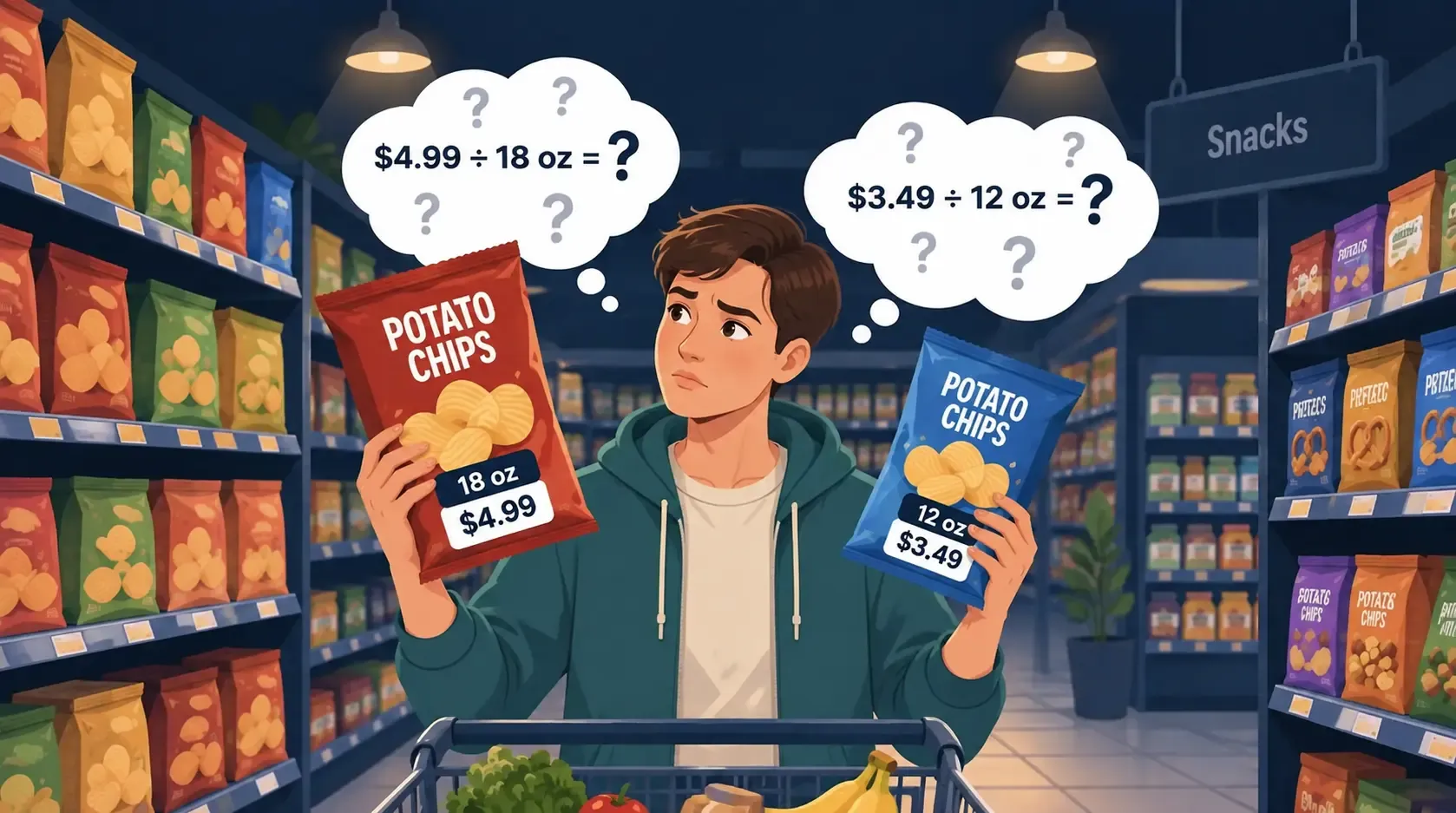
What Does Price Per Ounce Mean in Grocery Shopping?
The price per ounce represents the standardized financial cost of exactly one dry avoirdupois ounce (28.35 grams) of a product. In modern supermarket merchandising, shelf stickers display a bold total package price designed to catch your eye. However, package weights vary unpredictably across competing brands, product tiers, and even different production runs of the same item.
When Brand A sells a 14.5 ounce box of crackers for $3.89 and Brand B sells an 18 ounce family carton for $4.69, your eyes naturally register the $3.89 price tag as lower. But that raw dollar amount tells you nothing about which box offers superior value. The only mathematically honest metric is the unit rate: how many cents you spend for every single ounce of actual food entering your pantry.
By reducing different retail boxes to a single uniform baseline (cost per ounce), you instantly neutralize marketing psychology, colorful box dimensions, and deceptive package indentations. You can determine with complete clarity whether paying an extra dollar at the register yields a substantial discount per unit or merely purchases unnecessary cardboard.
Quick Example: A 14.5 oz box of crackers priced at $3.89 yields an equation of $3.89 ÷ 14.5 oz = $0.268 per ounce (26.8 cents per ounce). An 18 oz box at $4.69 yields $4.69 ÷ 18 oz = $0.261 per ounce (26.1 cents per ounce). The 18 oz box delivers a 2.6% financial savings per ounce.