

UnitPriceCheck LogoUnitPriceCheck

Price Per Gram Calculator

Determine the exact cost per gram for high-value herbs, spices, baking yeast, loose teas, and dietary supplements. Compare small package quantities with sub-cent precision.

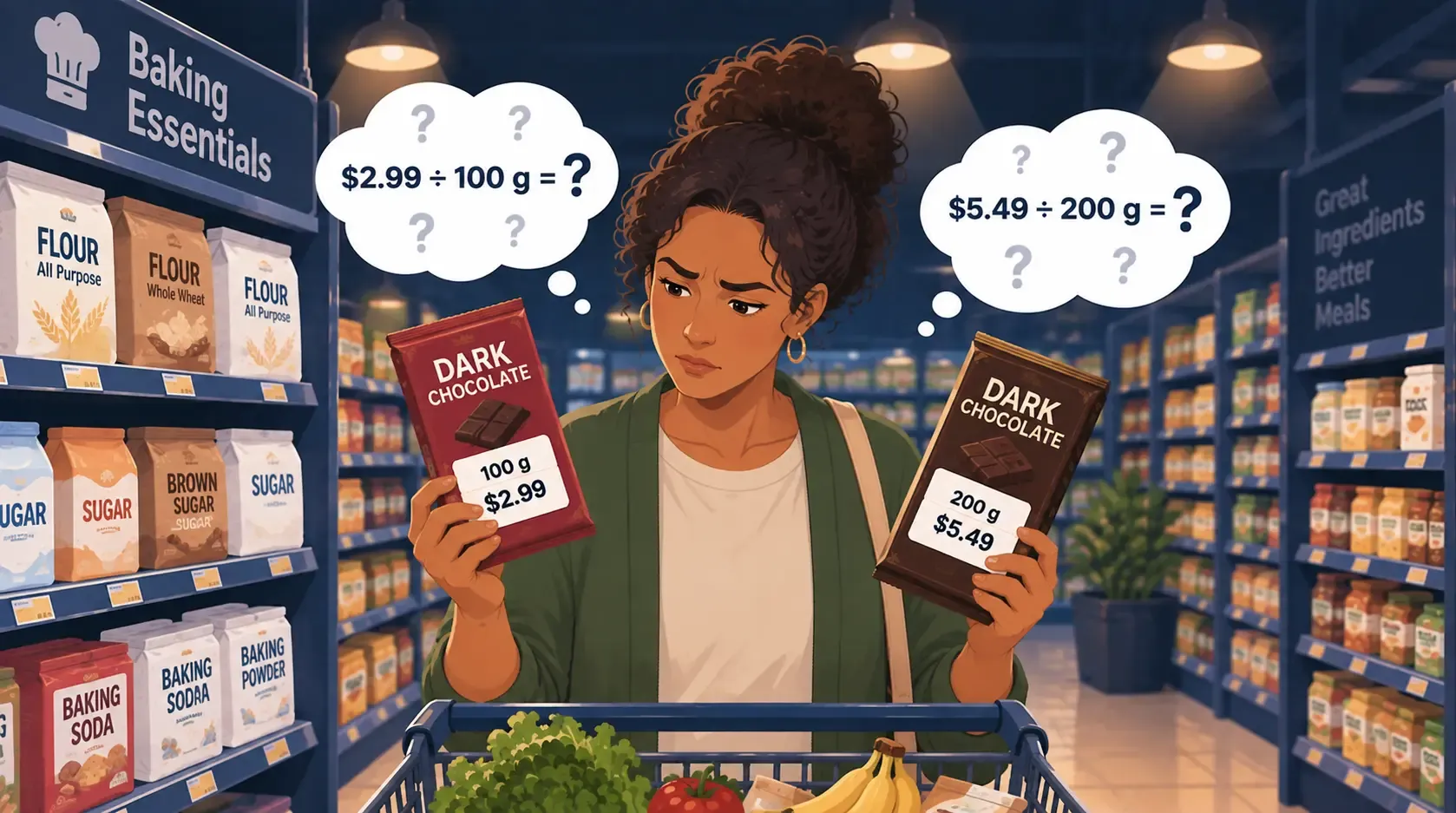
Shopper comparing products to calculate price per gram
g
The Core Rule: Price Per Gram = Total Price ÷ Net Weight in GramsCompare high-value spices, active yeast, vanilla pods, and supplements
$3.49 ÷ 28.35 g = $0.123 / g (12.3¢/g)
1

Option 1

$
g
2

Option 2

$
g
Ready to compare

Enter a price and size for both options above.

Results update automatically as you type.

Comparing multipacks?

Tap the + Multipack button above to enter item count, or enter the total combined quantity into the Size field (e.g. 6-pack of 12 oz entered as 72 oz).

General Need

Need a general unit price calculator?

Use the main UnitPriceCheck calculator for flexible comparisons across different unit types.

Specific Need

Looking for a specific calculator?

Browse the calculator directory to find the tool for your exact comparison.

Common Price Per Gram Benchmarks

Standard retail spice, tea, and specialty package rates.

7g Yeast Packet @ $0.89$0.127 / g12.7¢ per gram
28g (1 oz) Spice Jar @ $3.49$0.123 / gStandard shaker jar
100g Chocolate Bar @ $3.29$0.033 / g3.29¢ per gram
454g (1 lb) Bulk Yeast @ $8.49$0.019 / g1.87¢ per gram

The Economics of Micro-Weight Products: Why Price Per Gram Matters

The price per gram measures the cost for exactly one single metric gram (0.03527 dry ounces) of a concentrated product. While grocery staples like flour, potatoes, and milk are bought in multi-pound or multi-liter volumes, supermarkets contain entire aisles of concentrated, high-potency ingredients sold in tiny fractions: ground spices, whole vanilla pods, saffron threads, active dry yeast, artisan teas, herbal extracts, and powdered supplements.

In these micro-weight categories, measuring cost per pound or cost per ounce creates practical friction. An individual glass spice shaker might weigh only 1.2 ounces (34 grams) and sell for $3.99, while an ethnic market bulk pouch contains 400 grams for $6.99. The package appearances, materials, and shelf placements are so divergent that standard visual estimation fails entirely.

Calculating unit pricing down to the exact gram reveals some of the most staggering retail markups in the modern grocery store. Retail shakers frequently mark up identical culinary spices by 400% to 900% compared to refill bags. Our calculator evaluates these small quantities with exact sub-cent arithmetic, uncovering dramatic pantry savings that compound over months of home cooking.

The Fundamental Price Per Gram Formula
Price Per Gram = Total Package Price ÷ Net Weight in Grams

The Sub-Cent Precision Rule: Because one gram is so light, the result often costs fractions of a cent (e.g. $0.0245/g). Rounding aggressively to two decimal places ($0.02) discards 22% of the actual number, creating massive calculation distortions. Our tool maintains sub-cent precision (three to four decimal places) to preserve true mathematical accuracy.

How to Calculate Price Per Gram on Small Packaging

Follow this clear procedure when inspecting small containers, bottles, or supplement pouches:

1

Find Gram Net Weight

Read the bottom of the front label. If listed in ounces, look inside the adjacent parentheses for the metric gram total (e.g. 1.5 oz / 42 g).

2

Divide Shelf Price

Divide the total price by the gram count. For a $3.49 jar containing 42 grams, compute: $3.49 ÷ 42 = $0.0831 per gram (8.31 cents).

3

Compute Product 2

Repeat the division for the second product option (such as a larger bulk refill bag or competing brand) using the identical formula.

4

Observe Savings

Compare the two per-gram figures. In spice and supplement categories, unit savings often exceed 50% to 75% between formats.

Real-World Specialty Comparisons: Cost per Gram in Action

Micro-weight calculations demonstrate enormous differences between fancy retail dispensers and economical packaging. Here are four mathematically verified examples:

Example 1: Madagascar Bourbon Vanilla Beans (Glass Tube vs Vacuum Pouch)

Baking Aisle

Whole gourmet vanilla beans are packaged either as single or twin beans in glass vials, or as vacuum-sealed baker packs containing 10 whole beans.

Option A: 2-Bean Glass Tube

Net: ~6 g | Price: $11.99

$11.99 ÷ 6 g = $1.9983 per gram

Option B: 10-Bean Vacuum Pouch (Winner)

Net: ~30 g | Price: $34.99

$34.99 ÷ 30 g = $1.1663 per gram

Verdict: The vacuum pack saves 41.6% per gram ($0.832 saved per gram). For home bakers making extracts or custards, buying multi-bean packs delivers massive savings.

Example 2: Ground Cinnamon (Standard Glass Shaker vs International Market Bag)

Spice Rack

Comparing a commercial 42g spice jar in the baking aisle with a 450g bulk bag from the international market aisle illustrates the cost of branded packaging.

Option A: 42g Supermarket Shaker

Weight: 42 g | Price: $3.49

$3.49 ÷ 42 g = $0.0831 per gram (8.31¢/g)

Option B: 450g International Bag (Winner)

Weight: 450 g | Price: $8.99

$8.99 ÷ 450 g = $0.01998 per gram (2.00¢/g)

Verdict: The bulk bag delivers an astounding 75.9% savings per gram. The small shaker costs more than four times as much for the exact same ground spice.

Example 3: Baking Yeast (3-Packet Strip vs 1 lb Vacuum Brick)

Bread & Baking

Standard yeast envelopes are sold in strips of three 7g packets (21g total), while wholesale clubs and baking suppliers sell 1 lb (454g) vacuum bricks.

Option A: 3-Packet Strip (21g total)

Weight: 21 g | Price: $2.29

$2.29 ÷ 21 g = $0.1090 per gram (10.90¢/g)

Option B: 454g (1 lb) Vacuum Brick (Winner)

Weight: 454 g | Price: $6.49

$6.49 ÷ 454 g = $0.01429 per gram (1.43¢/g)

Verdict: The vacuum brick reduces cost per gram by 86.9%. Storing the vacuum brick in a sealed Mason jar in the freezer keeps yeast active for over two years while saving over $40 across equivalent bread loaves.

Example 4: Pure Saffron Threads (1 Gram Blister vs 5 Gram Tin)

Gourmet Pantry

Saffron is the world's most expensive culinary spice by weight. Because quantities are measured in single grams, calculating per-gram savings directly preserves dollars.

Option A: 1g Supermarket Blister

Weight: 1.0 g | Price: $8.99

$8.99 ÷ 1.0 g = $8.990 per gram

Option B: 5g Sealed Tin (Winner)

Weight: 5.0 g | Price: $31.99

$31.99 ÷ 5.0 g = $6.398 per gram

Verdict: Buying the 5g tin saves 28.8% per gram, saving $2.592 on every single gram of saffron. For paellas and risottos, this difference keeps gourmet cooking economical.

Categories Where Price Per Gram Exposes Massive Markups

Whenever products are sold in quantities under 100 grams, calculating unit costs on a per-gram basis reveals huge consumer premiums:

Dried Herbs & Rubs

Glass shakers of dried oregano or basil weigh only 15g to 25g because dried leaves have high volume but minimal weight. Paying $4.29 for 20g of oregano equals over $0.21 per gram ($95 per pound).

Powdered Supplements

Creatine monohydrate, electrolyte powders, and collagen peptides are sold in tubs ranging from 150g to 1,000g. Calculating per gram ensures you are paying for active ingredients rather than branded canisters.

Artisan Loose-Leaf Teas

Specialty matcha, oolong, and white teas are measured in grams. Standard retail tins usually contain 30g to 50g. Refill pouches offer unit costs 30% to 50% lower on identical harvests.

Micro-Weight Reference: Translating Grams into Practical Portions

Standard small metric weights and calculated rates per gram.

Micro-Weight Portion & Per-Gram Reference Table

Standard spice and specialty weight points with per-gram pricing

Grams (g)Ounces (oz)Culinary Measure ApproxIllustrative Shelf PriceCalculated Price Per Gram
1 g0.035 ozPinch of dried herbs$7.99$7.990/g (Saffron)
7 g0.247 oz1 standard yeast packet (2 1/4 tsp)$0.89$0.127/g
28.35 g1.000 ozSmall spice shaker portion$3.49$0.123/g
50 g1.764 ozGourmet tea tin$5.99$0.120/g
100 g3.527 ozStandard European chocolate bar$3.29$0.033/g (3.29¢/g)
454 g (1 lb)16.000 ozWholesale spice or yeast bag$8.49$0.019/g (1.87¢/g)

When Price Per Gram Helps Most

  • ✓International Food Aisles: Cellophane spice bags in Hispanic and Asian aisles offer identical spices at 60% lower per-gram rates.
  • ✓Refilling Glass Shakers: Buying bulk dry spices and refilling existing pantry containers saves substantial packaging markups.
  • ✓Bulk Baking Yeast: Buying a 1-pound vacuum brick of instant yeast costs under $0.02/g compared to $0.13/g for paper sachets.
  • ✓Precision Kitchen Scales: Using inexpensive 0.1g digital scales to portion bulk purchases into airtight jars.

Common Micro-Weight Mistakes

  • ✕Buying Pre-Ground Infrequently Used Spices: Ground spices lose volatile flavor oils after 6 months; whole seeds retain potency for years.
  • ✕Paying Spice Rates for Salt and Starch: Seasoning blends frequently list salt and maltodextrin as the main ingredients.
  • ✕Overpaying for Glass Shaker Caps: Glass jars with fancy lids often account for 70% or more of the shelf retail price.
  • ✕Two-Decimal Rounding Blindspots: Relying on standard rounding when differences between $0.014/g and $0.007/g represent a 100% price gap.

Frequently Asked Questions About Price Per Gram

Common questions about micro-weight calculations, spice packaging, and sub-cent precision.

Why do spices in glass jars carry such high prices per gram?

When you buy a brand-name spice jar, over 70% of the shelf price pays for packaging manufacturing, the plastic shaker cap, retail slotting allowances, freight shipping of heavy glass, and brand marketing. The actual dried agricultural spice inside often costs less than twenty cents.

How do I convert price per gram to price per ounce?

One dry ounce equals approximately 28.3495 grams. To convert a price per gram into price per ounce, multiply the per-gram rate by 28.3495. For example, tea priced at $0.10 per gram costs $0.10 × 28.3495 = $2.835 per dry ounce.

How do I convert price per gram to price per 100 grams?

Simply multiply the per-gram price by 100 by shifting the decimal point two places to the right. For example, a supplement costing $0.045 per gram costs $0.045 × 100 = $4.50 per 100 grams. For standard grocery comparisons, check our Price Per 100g Calculator.

Can I use this tool to compare liquid extracts measured in grams?

If the packaging lists its contents by weight in grams (common in baking pastes, concentrated vanilla bean pastes, and essential oils), yes. However, if the liquid is measured by volume in milliliters or fluid ounces, use our specialized volume calculators to ensure accurate mathematical comparisons.

How do I compare a product in grams against one in ounces?

Our calculation engine handles cross-unit conversions automatically. Select 'g' for Product 1 and select 'oz' for Product 2. The calculator normalizes both items to an identical baseline, showing you the percentage savings and the cheaper product immediately.

Why does the calculator show three or four decimal places for grams?

Because a gram is such a small unit of mass, standard two-decimal currency rounding rounds numbers like $0.014 and $0.007 to $0.01, obscuring the fact that one option is literally twice as expensive as the other. Multi-decimal precision preserves true cost comparisons.

Does the weight of the glass bottle or shaker lid affect the calculation?

No. By law, declared net weights reflect only the contents inside the container, excluding the glass shaker, plastic cap, and seal. You are calculating the price of the actual spice or supplement itself.