

UnitPriceCheck LogoUnitPriceCheck

Grocery Unit Price Calculator

Compare two grocery products side-by-side. Enter the price and package size for each, and the calculator finds the lower unit price instantly. No math required.

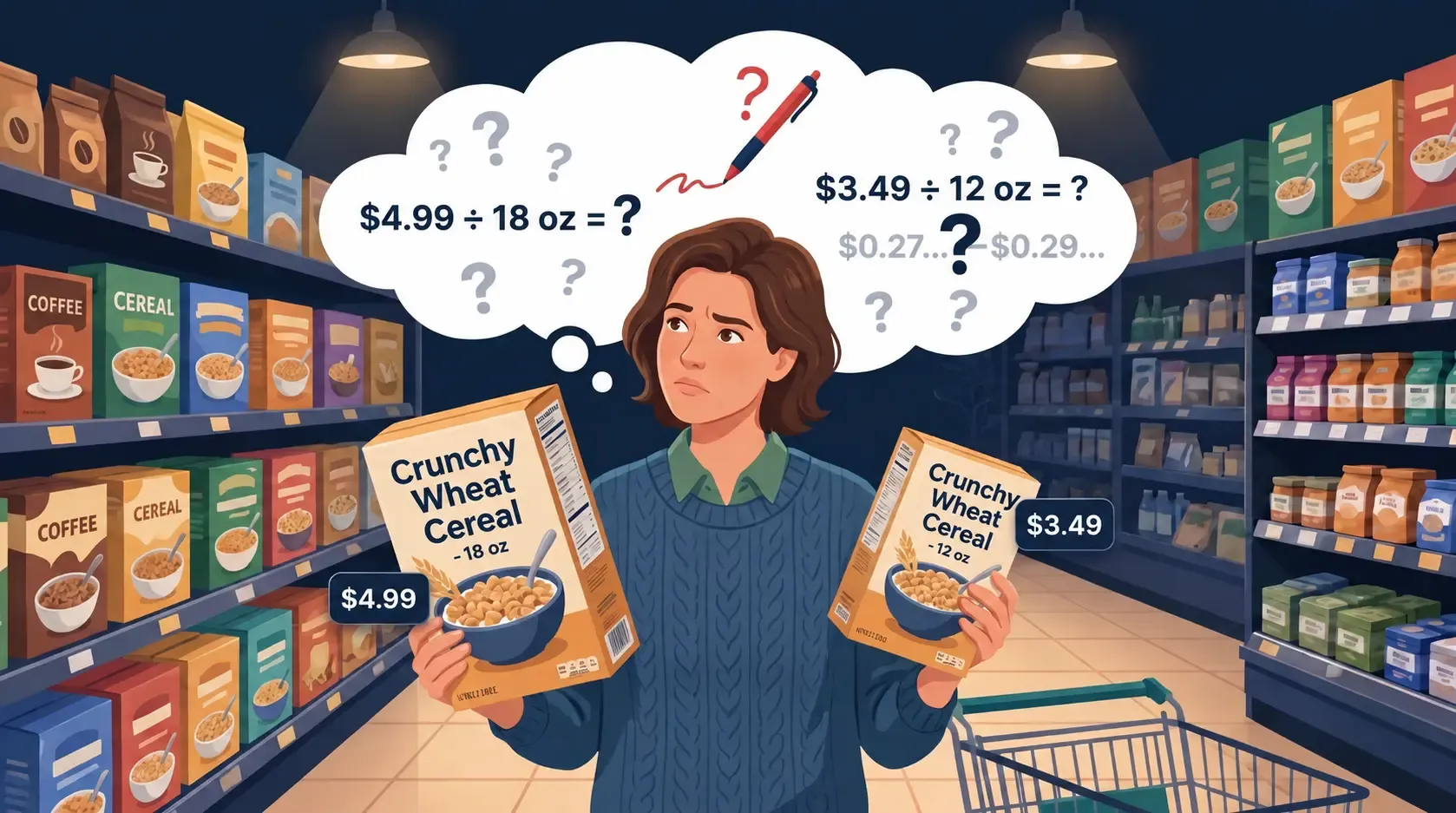
Grocery shopper comparing product prices to calculate unit price
๐Ÿ›’
The Core Rule: Unit Price = Total Price รท Package QuantityNormalize any two package sizes to find the true deal before reaching the checkout aisle
$4.99 รท 12 oz = $0.416 / oz
1

Option 1

$
2

Option 2

$
Ready to compare

Enter a price and size for both options above.

Results update automatically as you type.

Comparing multipacks?

Tap the + Multipack button above to enter item count, or enter the total combined quantity into the Size field (e.g. 6-pack of 12 oz entered as 72 oz).

General Need

Need a general unit price calculator?

Use the main UnitPriceCheck calculator for flexible comparisons across different unit types.

Specific Need

Looking for a specific calculator?

Browse the calculator directory to find the tool for your exact comparison.

Standard Grocery Price Benchmarks

Quick reference unit price rates for everyday grocery staples and common package sizes.

16 oz Standard Box @ $2.99$0.187 / oz18.7ยข per ounce
24 oz Family Size @ $4.99$0.208 / oz20.8ยข per ounce
32 oz Value Tub @ $5.99$0.187 / oz18.7ยข per ounce
64 oz Club Pack @ $9.99$0.156 / oz15.6ยข per ounce

What Is a Grocery Unit Price?

A grocery unit price is what you actually pay per ounce, pound, gram, or other unit of a product. The shelf price tells you the total cost of the package. The unit price tells you the cost of one unit of what's inside.

This matters because two packages at different prices are not directly comparable without knowing their sizes. A $4.99 box of cereal looks cheaper than a $6.49 box, until you notice the second box contains 50% more cereal. At that point, the cheaper-looking box is actually the worse deal.

Unit pricing creates a level playing field. Once you calculate price per ounce (or per pound, per gram, or per item), any two products become directly comparable regardless of package size.

Grocery Unit Price Formula
Unit Price = Total Price ÷ Package Quantity

Example: A 12 oz box of cereal priced at $4.99 costs $4.99 ÷ 12 oz = $0.416/oz. An 18 oz box at $6.49 costs $6.49 ÷ 18 oz = $0.361/oz. The larger box saves you 13.3% per ounce.

How to Use This Grocery Unit Price Calculator

The calculator above works in real time. No button to press. Results appear as you type.

1

Enter the Product Price

Type the shelf price for Product 1. For example: 4.99 for a box of cereal.

2

Enter the Package Size

Enter the quantity from the package label. For example: 12 for a 12 oz box.

3

Select the Unit

Tap the unit button and choose the right measurement: oz, lb, g, kg, fl oz, ml, l, or count.

4

Fill In Product 2

Repeat steps 1 to 3 for the second product. Units do not need to match.

5

Check the Result

The result panel shows which product wins and by what percentage. Done.

+

Comparing a Multipack?

Tap + Multipack to enter the item count. For example: 6 cans of 12 oz each.

Grocery Price Comparison Example

Here is a practical comparison you might face at the grocery store. Two boxes of cereal, same brand, different sizes.

1

Regular Box

  • Package size: 12 oz
  • Shelf price: $4.99
  • Unit price: $0.416 per oz
Better value
2

Family Box

  • Package size: 18 oz
  • Shelf price: $6.49
  • Unit price: $0.361 per oz

The family box costs $1.50 more at the register. But at $0.361/oz versus $0.416/oz, it delivers 13.3% more cereal for the same spend. A shopper who grabs the regular box because it costs less at checkout is actually paying more for what they get.

Calculation: ($0.416 - $0.361) / $0.416 × 100 = 13.3% savings per ounce.

Why the Bigger Package Is Not Always the Better Deal

The assumption that larger packages always cost less per unit is one of the most common grocery shopping mistakes. It holds true often, but not always.

  • Promotional pricing: Retailers often discount the regular size during a weekly sale. When a 12 oz bottle is on sale and the 20 oz is not, the smaller bottle can be cheaper per ounce.
  • Shrinkflation: Manufacturers sometimes reduce package size while keeping the price the same. The shelf still looks like the old size, but the unit price has risen quietly.
  • Club store markups: Large "warehouse" sizes are sometimes priced at higher unit prices than the equivalent standard retail size, relying on shoppers to assume bulk equals value.
  • Coupons and loyalty discounts: A coupon applied to the smaller size can flip which option is cheaper per unit entirely.

Comparing the unit price directly, as this calculator does, is the only reliable way to know which product is actually the better value on that day, at that store, with those prices.

Using This as a Grocery Shopping Price Estimator

The phrase "grocery shopping price estimator" covers several different things. Some shoppers use it to mean estimating the cost of an entire cart. Others use it to mean estimating the true unit cost of a single product before buying.

This calculator focuses on the second use: comparing the effective unit cost of two grocery products to determine which one gives you more for your money. You enter the price and size of each option, and the tool estimates the comparable cost per unit.

What this calculator does: Estimates and compares the effective unit cost (price per ounce, pound, gram, or item) of two grocery products so you can identify the better value before putting one in your cart.

Compare Groceries by Ounce, Pound, Gram, or Count

Grocery packages use a range of measurement standards depending on the product category and country. This calculator supports all of the common units used on grocery shelves:

Weight
  • oz (ounce): US grocery standard for cereal, snacks, cheese, and packaged meats.
  • lb (pound): Standard for produce, bulk goods, and deli items.
  • g (gram): Metric standard for imported products and specialty foods.
  • kg (kilogram): Used for larger bags of rice, flour, or pet food.
Volume
  • fl oz (fluid ounce): US liquid standard for beverages, sauces, and cooking oils.
  • ml (milliliter): Metric liquid standard for imported drinks and condiments.
  • l (liter): Used for bottled water, juice, and larger liquid containers.
Count
  • each / count: Used for eggs, dishwasher pods, diapers, paper towels, and individually priced items.
Important: Weight and volume cannot be compared directly (for example, 100 g vs 100 ml) because different products have different densities. The calculator will notify you if you enter incompatible unit types. Comparing products of the same unit category (weight vs weight, volume vs volume, count vs count) always works.

Example Grocery Unit Price Comparison Table

These examples illustrate how unit pricing works across common grocery items. Prices are for illustration only and do not represent any specific retailer.

ProductPackagePriceUnit PriceResult
Cereal A12 oz$4.99$0.416/oz
Cereal B18 oz$6.49$0.361/ozBetter value (13.3% less/oz)
Coffee A12 oz$8.99$0.749/oz
Coffee B20 oz$13.99$0.700/ozBetter value (6.6% less/oz)
Rice A32 oz$3.49$0.109/oz
Rice B64 oz$5.99$0.094/ozBetter value (14.2% less/oz)
Pasta A16 oz$1.89$0.118/oz
Pasta B500 g$2.49$0.141/ozPasta A wins (16.3% less/oz)

Pasta A vs B comparison converts 500 g to its ounce equivalent (17.64 oz) for a fair weight-to-weight comparison. The calculator handles this automatically.

Practical Grocery Shopping Tips

  • โœ“Compare unit price, not shelf price: The sticker price tells you what you owe at checkout. The unit price tells you what you are actually getting for your money.
  • โœ“Check the measurement basis: One product might show ounces, another might show grams. This calculator normalizes them automatically, but always double-check the printed label.
  • โœ“Factor in your actual coupon price: Enter the post-coupon price to see the real unit cost comparison. Coupons on standard sizes frequently flip the result.

Common Shopping Mistakes

  • โœ•Assuming bulk packaging is cheaper: Always verify. Stores know shoppers assume bigger means cheaper and sometimes price larger formats at higher per-unit margins.
  • โœ•Ignoring food waste and spoilage: A better unit price is only a real saving if you use the product before it expires. Throwing away food negates unit savings.
  • โœ•Misreading gross weight for net weight: Some packages include heavy syrup, brine, or packaging weight. The printed net weight is what counts for unit price comparison.

Grocery Unit Price Calculator FAQ

Common questions about comparing grocery prices and using this calculator.

What is a grocery unit price?
A grocery unit price is the cost of one standard unit of a product: one ounce, one pound, one gram, one liter, or one item. It is calculated by dividing the total package price by the total package quantity. Unit pricing lets you compare products of different sizes on an equal basis.
How do I compare grocery prices when package sizes are different?
Enter both products into this calculator: price and package quantity for each. The calculator converts both to a common unit automatically and shows which product costs less per unit. You do not need to do any math manually.
How do I calculate price per ounce?
Divide the total price by the number of ounces. If a 16 oz jar costs $4.79, the price per ounce is $4.79 divided by 16 = $0.299 per ounce. Enter the price and size into the calculator above and select "oz" to get this instantly.
Is a larger grocery package always cheaper per unit?
Not always. Sale prices on regular sizes, coupons, and pricing strategies from retailers can make the smaller package the better unit value on any given day. Always verify by comparing the actual unit prices rather than assuming size equals savings.
Can I compare price per pound and price per ounce?
Yes. Both pounds and ounces are weight measurements, so the calculator converts them to a common base (grams internally) and compares them directly. Enter one product with "lb" and another with "oz" and the result will be accurate.
Can I use this calculator for products sold by count?
Yes. Select "each" or "count" from the unit picker for products priced by item: eggs, dishwasher pods, diapers, paper rolls, or individually wrapped portions. The calculator will show the price per item and compare the two options.
What is the difference between package price and unit price?
The package price is the total amount you pay at checkout for the whole product. The unit price is the cost broken down per ounce, pound, gram, or item. Two products with very different package prices can have identical unit prices, or the cheaper-looking package can have the higher unit price. The unit price is the meaningful comparison point.
Can I use this as a grocery shopping price estimator?
This calculator estimates the effective unit cost of individual grocery products and compares two options side-by-side. It does not estimate the total cost of a full shopping cart. Use it to evaluate specific purchasing decisions: which pasta to buy, which bottle of olive oil is the better value, or whether the larger pack of paper towels is actually cheaper per roll.